More Than Long Hair
What My Angora Mice Have Been Trying to Tell Me
When most people see an Angora mouse, they notice the hair first. That is fair. There is quite a lot of it. Some resemble tiny clouds. Others look as though they’ve backed into an electrical socket. The most extreme coats can make a mouse appear twice its actual size until it turns sideways and reveals that half the mouse was apparently an optical illusion made of fluff.
For years, I treated Angora mainly as a coat variety. I selected for longer, denser, more evenly spread hair while also trying to improve type, temperament, and health.
Then my records began bothering me. Some of my most heavily coated mice were slow to breed or never produced a litter. Across parts of several different lines, I also recorded small litters, weak grip, loose joints, odd movement, and reproductive abnormalities.
One unusual mouse can be chance. Two can be unfortunate.
When similar concerns begin appearing across several lines and generations, however, my breeder brain starts building spreadsheets. That is how this project began.
A Very Important Bucket of Cold Water
This is unfinished work.
My records come from a working mousery, not a controlled laboratory. Age, relatedness, illness, environment, other genes, breeding choices, and plain bad luck may all have affected the results.
My dataset currently includes five Angora lines from different branches of the established fancy population. I call them separate lines because they reached me through different breeders or family branches, but that does not guarantee they are genetically unrelated. Fancy mice travel between breeders, pedigrees are not always complete, and distant shared ancestry can be surprisingly difficult to escape.
I am also beginning to follow a sixth Angora line already present in pet store stock, with no known connection to the fancy Angora population. It is much too new to answer anything yet, but it may eventually provide an important comparison.
In other words, I have found something interesting enough to investigate. Not something solid enough to carve into a scientific stone tablet.

So… Did Fancy Angora Come From a Laboratory?
This is where the history became much more interesting than I expected. There is a common idea that fancy Longhaired mice must have come from laboratory Angora stock. For a while, I thought the history disproved that.
It does not.
The classical laboratory Angora mutation, Fgf5go, arose spontaneously in the BALB/cJ laboratory strain and was reported in 1963. MGI identifies it as a recessive intragenic deletion affecting exon 1 of Fgf5.
The National Mouse Club, meanwhile, lists A. D. Jones as receiving the Longhaired certificate in 1969. The current NMC standard still carries that credit. By August 1968, Longhaired was already being discussed in Fur and Feather as one of the new varieties on probation, meaning the fancy strain was clearly being worked before the certificate was awarded.
That places the emergence of the standardized fancy Longhaired after the laboratory go mutation had already been reported. So can I say fancy Angora definitely did not come from laboratories?
No.
Can I say it definitely did?
Also no.
I have not yet found a source explaining where A. D. Jones’s original Longhaired stock came from. Inconveniently for anyone who enjoys a simple answer, we do know that laboratory Longhaired mice entered the British fancy at some point. A later NMC historical article describes Roger Hutchings rebuilding Longhairs using poor quality specimens obtained from laboratories. That does not prove Jones’s original mice came from laboratory go. Hutchings appears to have been rebuilding a variety that already existed.
But it does prove that “laboratory mice never entered the fancy” is not a safe assumption either. So for now, the origin of modern fancy Angora remains a tiny genetic cold case.
Possible answers include:
the original fancy Longhair came from laboratory Fgf5go stock;
it arose independently in fancy or pet stock;
it came from another undocumented longhair source;
or more than one longhair mutation entered the fancy and was eventually grouped under the same variety name.
History has provided me with suspects. Unfortunately, it has misplaced the security footage.
Why lgh Is Still a Poor Match
Long hair can come from more than one mutation, so “the mouse is fluffy” is not enough to identify the gene. Genetics is rarely polite enough to make things that easy. The known lgh/lgh phenotype does not match fancy Angora particularly well. Mouse Genome Informatics describes homozygous lgh mice as lacking zigzag hairs in the underfur of the body and frequently developing skin lesions. It does not say they begin life with zigzag hairs and gradually lose them after molting or as they age. That extra timeline appears to have been added by google and other AI summaries rather than supported by the MGI description.
Fancy Angoras normally retain a dorsal undercoat and do not routinely develop the frequent skin lesion syndrome described in lgh/lgh mice.
I also examined a clipping from one of my post molt Satin Angoras under a microscope. Among the mostly straight and gently curved hairs, I found a very fine shaft with several alternating bends that appears consistent with a zigzag hair.

One probable zigzag from one mouse does not settle the genetic identity of an entire variety. It does show that this individual did not completely lack zigzag hairs.
That makes lgh/lgh an unlikely match.
Why FGF5 Is Still My Leading Suspect
The classical Fgf5go phenotype is a much closer physical match. FGF5 stands for fibroblast growth factor 5, which sounds like a phrase specifically designed to frighten people away from genetics articles.
In plain language, FGF5 helps tell a hair follicle when it is time to stop actively growing. Hair grows in stages. During anagen, the hair lengthens. FGF5 helps move the follicle out of that growing stage. When normal FGF5 signaling is lost, anagen lasts longer and the hair becomes unusually long. MGI describes the classical go allele as a spontaneous recessive deletion involving exon 1 and notes FGF5’s role as an inhibitor of hair elongation.
Fancy Angora behaves as a recessive trait, affects the whole coat, retains an undercoat, and does not normally show the lgh-like lesion syndrome. That makes altered FGF5 signaling a reasonable leading suspect. It does not prove that fancy Angora carries the exact laboratory go deletion.
The laboratory mutation offers another clue. Its zigzag hairs have four segments rather than the usual three, and the three segments nearest the tip are longer. All major hair types are also significantly longer, with guard hairs showing the greatest increase.
Once my microscope is professionally cleaned, and once I regain the patience required to separate individual mouse hairs without launching them into another dimension, I plan to count those sections in fancy Angora zigzags. If they repeatedly have four segments, classical Fgf5go becomes a closer match.
If they consistently have the usual three, another allele or mutation becomes more interesting. Either result would be useful.
Neither would be a DNA confession.
Why I Started Looking Beyond the Coat
FGF5 belongs to a much larger fibroblast growth factor family. These signals share receptors and downstream pathways involved in growth, survival, development, and repair. That does not mean changing Fgf5 automatically breaks every other FGF gene.
Genes are not dominoes standing in a neat row. I think of it more like a workplace. Different employees have different jobs, but some share hallways, equipment, and communication systems. If one disappears, everybody else may continue normally.
Or… someone else may compensate.
That gives me a reasonable question:
Could changing one signal indirectly affect another part of the system?
Maybe. It is equally possible that FGF5 affects only the coat while another gene is hitchhiking beside it.
Genetics has given me several suspects, and none of them have confessed.
What My Records Show So Far
I score coats for length, density, and distribution, then compare breeding outcomes between lower scores of 1-2 and higher scores of 3-4. The clearest pattern appeared in coat length. Among pairings involving high-length mice, about 14% bred successfully within the expected time. Around half were delayed, and approximately 36% failed.
Among lower-length mice, about 63% were successful, 24% were delayed, and about 12% failed.

Those numbers did not gently tap me on the shoulder. They grabbed me by it.
The difference appeared strongest among males. None of the seven pairings using a high-length sire was normally successful. Three were delayed and four failed. By comparison, 14 of 20 pairings using lower-scoring sires were successful.
High-density sires also had more trouble. Only one of six pairings was successful, while four failed.
That is striking.
It is also based on small groups. Seven males are not seven hundred. Some animals are related, and some were used in more than one pairing.
The responsible conclusion is not “Extreme Angora coats cause infertility.” It is “The most extreme coats, especially in males, have appeared beside poorer breeding outcomes often enough that I need to keep watching.”
The data are saying, “Look closer.”
They are not saying, “Case closed.”
Other Traits and Other Suspects
Across parts of these lines, I have recorded weak grip, loose or unusually flexible joints, odd movement, and reproductive organs that appeared unusually small or absent during necropsy.
These problems do not occur in every Angora.
Some extremely coated mice remain healthy, and many other factors can muddy the picture.
One possibility is linkage. Genes that sit close together on a chromosome are more likely to be inherited together. By repeatedly selecting a visible coat trait, breeders can accidentally keep selecting a nearby invisible problem. Imagine choosing the same passenger because they are wearing an excellent fluffy coat, only to discover that they keep bringing an extremely inconvenient friend. In that case, the longhair mutation may be innocent while a neighboring gene causes the trouble.
Another possibility is pleiotropy, which means one gene affects more than one trait. Genes are often introduced to us as though each has one tidy little job. One gene for coat length, another for fertility, another for joints.
Biology is rarely that organized.
A gene may act in more than one tissue, or the signal it controls may affect several parts of development. If the Angora mutation itself influences coat growth and also contributes to reproduction, movement, connective tissue, or another body system, that would be pleiotropy.
I am not claiming that is what is happening. It is simply another reason I am looking beyond the hair. The coat may be the most obvious effect without necessarily being the only one.
Why the Sixth Line Matters
The Angora phenotype was already present in the pet store population. I am not introducing Angora from my fancy lines yet.
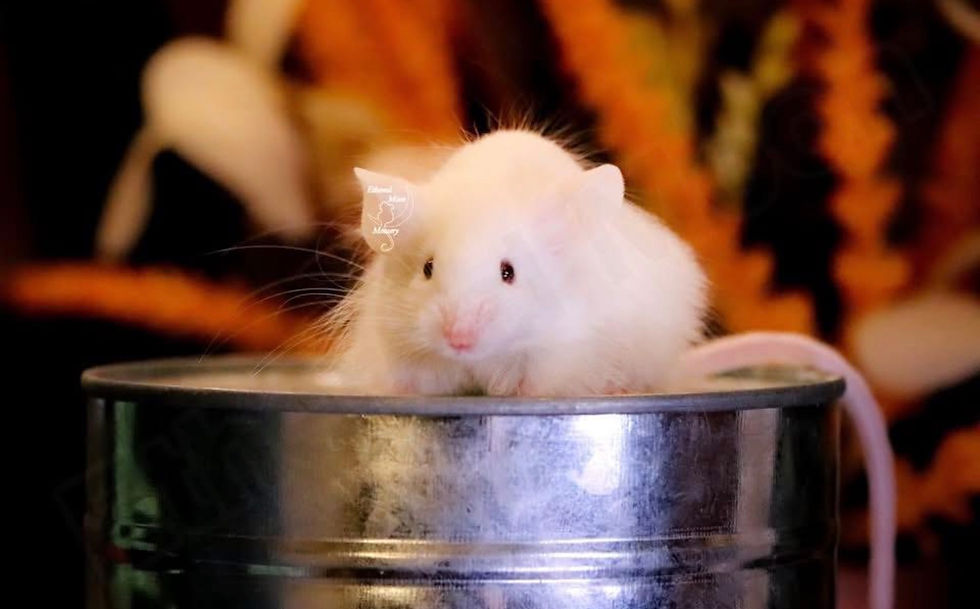
First, I want several generations of data from that population on its own. That gives me a useful comparison. If the pet store Angoras remain healthy through several generations of selection but similar problems appear after fancy stock is introduced, that could point toward a linked genetic “hitchhiker” or other background problem traveling within the fancy population.
If the same concerns appear in the separate pet store population before any fancy Angora is added, a broader connection to Angora becomes more interesting. If they do not, shared ancestry within the fancy becomes a stronger suspect.
Either result matters. Unfortunately, one pet store Angora cannot settle the case. Genetics prefers several generations, detailed records, and an unreasonable number of tiny family trees before giving up any of its secrets.
What Comes Next
I plan to keep tracking coat scores, parent ages, time to litter, litter size, failed pairings, grip, joints, movement, offspring survival, reproductive anatomy, temperament, and necropsy findings. I also need better comparisons among standard coated littermates, carriers, homozygous Angoras, unrelated lines, and both sexes.
Temperament has not followed the same pattern as fertility, which matters too. Sometimes the data may say, “Maybe.”
Sometimes they may say, “Probably not.”
Occasionally they definitely say, “Please stop staring at the spreadsheet and go to bed.”
Microscopy may help describe the coat, but sequencing will ultimately be needed to identify the mutation. Fancy Angora may carry classical Fgf5go, another Fgf5 allele, multiple longhair mutations across different lines, or something else entirely.
I may also investigate a separate pattern I have noticed when Rex is introduced into Angora lines. Some crosses appear to improve fertility or physical soundness, but I do not yet know whether Rex itself is involved or whether the benefit simply comes from outcrossing into a different genetic background. That question needs its own records, and probably its own article.
Where Things Stand
The exact genetic identity, and even the historical origin of fancy Angora is still unresolved.
The laboratory Fgf5go mutation was reported in 1963. The NMC standardized Longhaired in 1969 under A. D. Jones, with Longhaired already appearing as a developing variety by 1968. Later records also show that laboratory Longhaired mice were used within the British fancy, although I have not found evidence proving that Jones’s original stock came from them.
Its retained undercoat, probable zigzag hairs, and lack of frequent skin lesions make lgh/lgh a poor match. Its overall coat makes altered FGF5 signaling a better suspect, but the exact mutation remains unconfirmed.
Meanwhile, my early records show a possible association between more extreme coats and poorer breeding success, especially among males. I have also observed grip, joint, movement, and reproductive concerns in parts of several lines.
Those findings deserve attention. They do not deserve exaggeration.
The cause may be the longhair mutation itself. It may be a linked gene, shared ancestry, or several unrelated problems that only look connected. Until somebody finds A. D. Jones’s missing 1960s mouse diary, or I eventually get DNA results, the historical and genetic parts of this mystery remain very much open.
For now, I will keep documenting, outcross carefully, avoid breeding severely affected mice, and allow future evidence to prove me wrong.
Science does not always begin when someone announces an answer.
Sometimes it begins when a breeder looks at a mouse they have seen every day and finally asks a better question.
Weird Mouse Fact
Ordinary mouse zigzag hairs usually have three segments, but the classical laboratory Angora mutation in Fgf5 produces zigzag hairs with four. Researchers also found that all major hair types become longer, with guard hairs showing the greatest increase.
I hope to compare this with fancy Angora hairs once my microscope is cleaned, because apparently my breeding project now includes counting microscopic mouse hair corners.
References:
Mouse Genome Informatics — Fgf5go / Angora spontaneous allele https://www.informatics.jax.org/allele/MGI%3A1856336
Mouse Genome Informatics — Fgf5go phenotype and hair morphology https://www.informatics.jax.org/allele/genoview/MGI%3A3603424
Mouse Genome Informatics — lgh / long hair marker https://www.informatics.jax.org/marker/MGI%3A96779
National Mouse Club — Longhaired standard; Certificate 1969: A. D. Jones https://thenationalmouseclub.co.uk/project/longhaired/
National Mouse Club — Rules and Standards, including Longhaired https://thenationalmouseclub.co.uk/rules-and-standards/
National Mouse Club — “Mice Matter!” historical article discussing Roger Hutchings obtaining longhaired specimens from laboratories https://thenationalmouseclub.co.uk/mice-matter/
AFRMA — Mouse fancy historical archive / Fur and Feather material https://www.afrma.org/booklisthistory.htm
Hébert et al., 1994 — FGF5 as a regulator of the hair-growth cyclehttps://pubmed.ncbi.nlm.nih.gov/7923352/
Mouse Genome Informatics: targeted Fgf5 mutation producing an Angora-like coathttps://www.informatics.jax.org/allele/MGI%3A1857847
These support that classical laboratory Angora is an Fgf5 allele, that exon 1 is deleted in go/go mice, that targeted disruption of Fgf5 creates a closely similar long-haired phenotype, and that FGF5 normally limits hair elongation.
Hair morphology and the four coat-hair types
Pennycuik and Raphael, 1984 — The angora locus in the mousehttps://www.cambridge.org/core/journals/genetics-research/article/angora-locus-go-in-the-mouse-hair-morphology-duration-of-growth-cycle-and-site-of-action/527711696A3D532C3DE480EC1C99C18C
PubMed record for the same paperhttps://pubmed.ncbi.nlm.nih.gov/6397398/
This study reports that all four coat-hair types were longer in go/go mice and that the increased length resulted from a longer active-growth period.
MGI detailed phenotype view for Fgf5 Angorahttps://www.informatics.jax.org/allele/genoview/MGI%3A3603424
This is the source used for the description of altered zigzag hairs, including the reported four segments instead of the ordinary three.
The separate lgh mutation
Mouse Genome Informatics: lgh gene detailhttps://www.informatics.jax.org/marker/MGI%3A96779
This states that homozygous lgh mice lack zigzag hairs in the body underfur and frequently develop skin lesions. It does not state that the mice first possess zigzag hairs and lose them with age.
Broader FGF-family explanation
NCBI Gene: FGF5https://www.ncbi.nlm.nih.gov/gene/2250
FGF5 reviewhttps://pubmed.ncbi.nlm.nih.gov/37957094/
Free full-text version of the FGF5 reviewhttps://pmc.ncbi.nlm.nih.gov/articles/PMC12535173/
These support the explanation that FGF5 is a signaling protein and a negative regulator of the hair-growth cycle. The broader FGF family participates in cell growth, survival, development and tissue repair.

