Not That Mouse: A Holiday Shopping Guide for Mouse Lovers
Finding gifts with whiskers, without disappearing into a sea of computer accessories.
You’re shopping for someone who loves mice. The animal. This distinction will become increasingly important. Type “mouse gifts” into a search bar and suddenly you’re shopping for a gaming setup. Add “cute” and Mickey arrives. Try “mouse burrow” and now you’re looking at enrichment for actual rodents. All perfectly reasonable things. None of them the woodland mouse cardigan you were hoping to find.
With the holidays approaching, I wanted to put together a guide for anyone trying to shop for a mouse lover, including those of us shopping for ourselves. After searching for mouse-themed knitwear and finding an impressive assortment of foxes and sweatshirts, I have a few suggestions.
Start with the mouse, then name the object

“Mouse-themed gifts” leaves a lot open to interpretation. Try combining a more specific description of the mouse with the item you want.
A few searches to experiment with:
● Field mouse brooch
● Harvest mouse ornament
● Woodland mouse cardigan
● Storybook mouse art print
● Botanical mouse mug
● Embroidered mouse sweater
● Ceramic mouse figurine
These are starting points, not magic passwords. Sellers don’t all describe their work the same way, so swap words rather than piling every possible keyword into one enormous search. Try “mice” as well as “mouse.” If “woodland mouse ornament” isn’t helping, try “Christmas mice ornament” or “felt mouse decoration.”
Give Google a little direction
Sometimes “mouse necklace” needs a little clarification before Google understands that you want whiskers, not a Disney vacation.
A few search tricks can help narrow things down:
Quotation marks request an exact phrase, such as "field mouse".
A minus sign excludes a word, such as -Mickey or -computer.
site: limits the search to a particular website, such as site:etsy.com.
Try:
"field mouse" necklace -Disney -Mickey -Minnie
Or:
site:etsy.com mouse cardigan -Disney -Mickey -Minnie -computer -gaming
These are useful tools, not a guarantee that your perfect mouse cardigan will emerge from the forest. Start with a few words and adjust as you go. Be careful about excluding too much, too. Adding -pattern might remove knitting patterns, but it could also hide a finished sweater described as having a “woodland pattern.”
These commands are intended for Google; a shop’s own search bar may work differently. If the results still aren’t helping, try searching directly within a marketplace or browsing a promising maker’s other items. Sometimes finding one good mouse is how you find the rest of the nest.

Search for the atmosphere, too
Sometimes the mouse is a small part of a larger design and never makes it into the product title. Words such as “woodland,” “storybook,” “botanical,” “cottagecore,” and “forest” can help you explore that surrounding style. You may still encounter enough foxes to populate an entire woodland, but you might also find a mouse tucked beneath a mushroom or hiding among the leaves.

One of my favorite finds was a Halloween cardigan with a tiny mouse dressed as a ghost. I found it while searching for woodland designs, without “mouse” in the search at all. Sometimes you really do have to look for the forest to find the mouse.
Look closely at the artwork. Some listings use “mouse” and “rat” together, and stylized animals don’t always match the label. Both are lovely animals, but if the recipient specifically loves mice, the actual design matters more than the keywords.

A cute picture doesn’t tell you how it’s made
This was the biggest lesson from my sweater search: finding the right animal is only half the job. Before buying clothing, check two separate things: what the fabric is made from and how the design is applied. A mouse can be printed onto fabric, embroidered onto it, or formed by different colors of yarn within the knitting. Those give very different results. A knitted fabric can still have a printed design, so the word “knit” alone doesn’t answer that question.
Look for:
● Fiber percentages: Cotton, wool, acrylic, polyester, and blends tell you more than “soft material.”
● Construction details: Is the mouse printed, embroidered, appliquéd, or knitted into the garment?
● Close-up photos: Can you see stitches, texture, seams, and the actual fabric?
● Customer photos and reviews: Do people describe the item you think you’re buying?
Printed clothing can be lovely. The disappointment comes when you expect a textured knitted mouse and receive a flat print instead.
Also watch for words such as “embroidery-style” or “knit-look.” They may describe the appearance rather than the construction.

Make sure you’re buying the finished thing
A beautiful mouse sweater photo might be advertising a knitting pattern. An ornament could be a kit. A charming illustration might be a digital download that you’ll need to print yourself.
Before getting attached, check whether the listing is for:
● A finished physical item
● A pattern or tutorial
● A craft kit
● A digital file
Then check dimensions and what’s included. A tiny mouse is delightful. An unexpectedly tiny gift because nobody read the measurements is a different experience.
Read the reviews that answer your questions
The overall star rating is a starting point. The useful details are often in the written reviews. For clothing, look for comments about softness, lining, transparency, fit, and washing. For jewelry or ornaments, check size, finish, fragility, and whether the item resembles the listing photos. Pay attention to the version being reviewed. A black dress review doesn’t establish whether the cream version is see-through. A review of a different size may not resolve your own fit questions.
A single bad review doesn’t tell the whole story, but repeated complaints deserve attention. Notice whether the complaint concerns the design, sizing, damage in transit, or an item arriving in poor condition. Those are different problems.
Check the measurements, not just the size label
Finding the perfect mouse sweater is exciting. Discovering that the sleeves stop halfway down your forearms is less exciting. Before ordering, compare your measurements with the size chart for that specific item. A large in one shop may fit differently from a large somewhere else.
Use a flexible measuring tape, wear the undergarments you plan to wear with the outfit, and stand naturally. Keep the tape snug without pulling it tight or pressing into your skin. For measurements around your body, keep it level.
Here are the basics to record:
Bust/chest: Measure around the fullest part. If you’ll wear a bra with the garment, measure with it on.
Waist: Measure around your natural waist, usually near the crease that forms when you bend sideways. Follow the seller’s instructions if they specify a different location.
Hips: Measure around the fullest part of your hips and butt, with your feet together.
Bicep circumference: Measure around the fullest part of your upper arm while it’s relaxed.
Thigh circumference: Measure around the fullest part of your upper thigh.
Arm length: With your elbow slightly bent, measure from the shoulder point, over the elbow, to your wrist. Some sellers measure sleeves from the center back of the neck instead, so check their diagram.
Leg length: For trousers, the inseam runs from the crotch down the inside of the leg to the intended hem. An outside-leg measurement starts at the waist instead, these aren’t interchangeable.
The worksheet pictured is a starting point, not a complete fit guide. Add any missing measurements, and clearly label arm and leg lengths separately from measurements around your biceps, thighs, or calves. Record the units, too!

Also check whether the seller lists body measurements or the measurements of the finished garment. Clothing often needs extra room for movement; a nonstretch garment measuring exactly the same as your body may feel restrictive. Measuring a similar item you already enjoy wearing can help, provided you use the same measuring method.
Even a detailed chart can’t guarantee the fit. Fabric stretch, lining, cut, and your preferred amount of room all matter. If an important measurement is missing, ask the seller, given the chance you can contact them, rather than assuming it will work.
And if you’re buying a gift, asking for measurements, or borrowing the measurements of a favorite sweater with permission, is much safer than guessing from a size label.
Think beyond the sweater
If clothing is becoming a sizing puzzle, there are plenty of other directions to explore:
● Small gifts: Mouse brooches, enamel pins, bookmarks, stickers, or ornaments.
● For a cozy home: Mugs, art prints, tea towels, or little ceramic mice for a shelf.
● For a storybook feeling: Felt mice, miniature scenes, or illustrated stationery. Searching for “burrowcore” can also give you alternate ideas on storybook vibes if you can’t find a mouse specific item.
● For something personal: A commissioned portrait of the recipient’s own mouse, if the artist has availability.
Shameless plug: Ethereal Moonlit Studios
These are gift ideas, not endorsements of a particular seller. Check materials and dimensions whichever direction you choose.
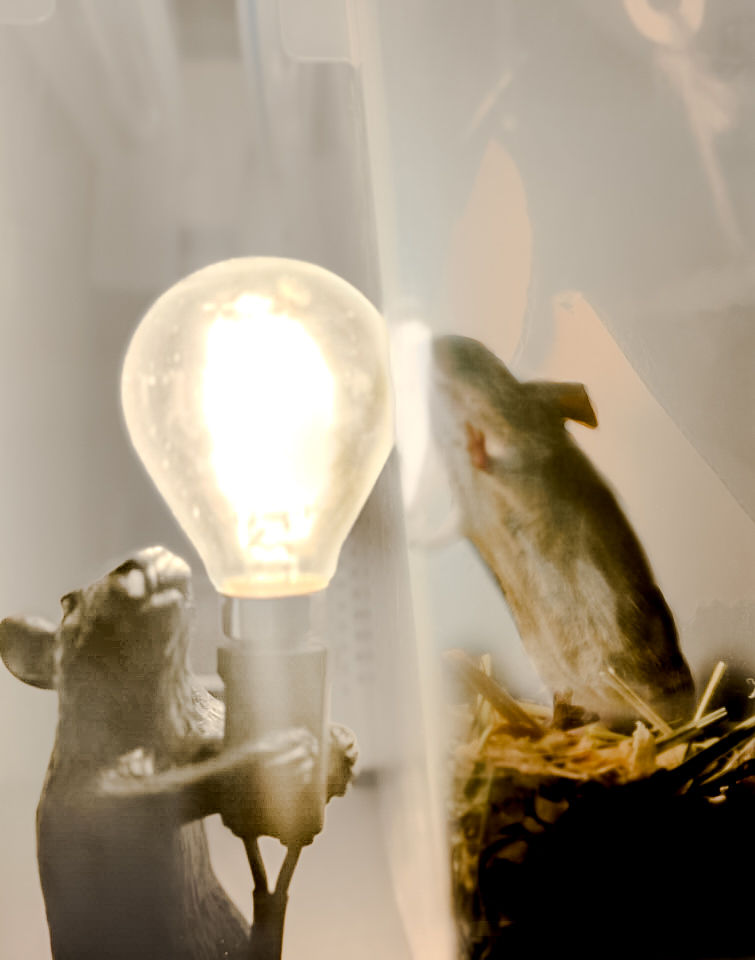

For custom or handmade gifts, check the maker’s processing time as well as delivery estimates. Before ordering, read the return terms too, especially for personalized items, and always keep an eye out if the seller contacted you. They may not be able to continue without a response.

The mouse is worth finding
A thoughtful mouse gift doesn’t have to be expensive. It might be a little ornament, a carefully chosen print, or a cardigan with one small mouse hiding near the hem. The important part is finding something that suits the person: their favorite colors, the materials they enjoy wearing, and the kind of mice they love.
And if you’ve spent half an hour explaining to a search bar that you mean a small whiskered woodland animal, please know you are not alone.
Somewhere out there is our mouse.
Probably behind seventeen fox sweatshirts.

Search reference
[1] Google Search Help: Refine Google searches. Search syntax checked October 12, 2026.


